You have been in it. Twice, maybe three times, this year.
The thing where you looked up and two hours were gone and the work was better than your normal work. You remember it clearly enough to want it back, and you have absolutely no idea how you got there, which is why you keep trying to arrange it by sitting down and hoping.
It is not a mood and it is not luck. It has conditions. And your ordinary working day is arranged, more or less perfectly, to break every one of them.
The idea, named
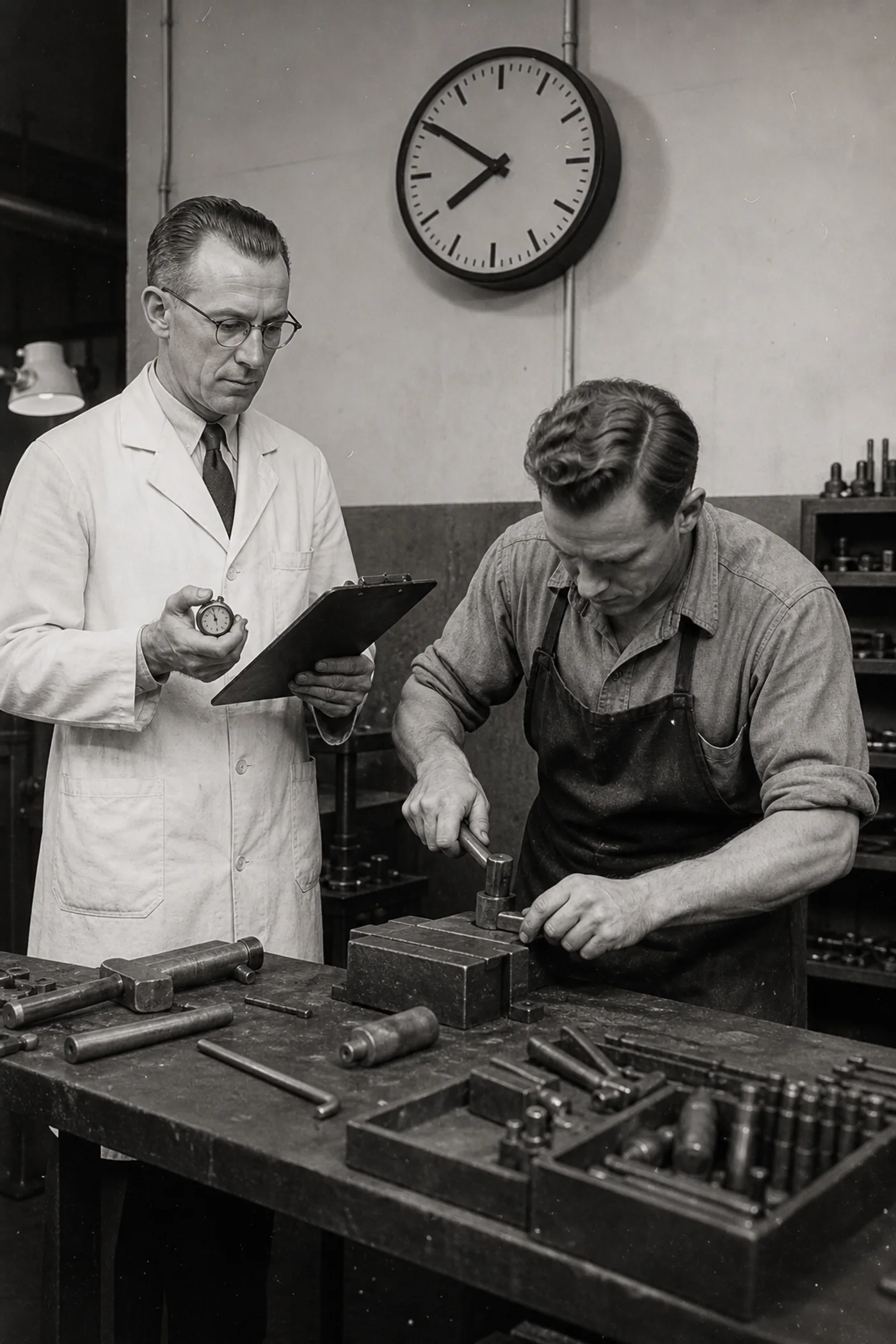
Flow. Mihaly Csikszentmihalyi, whose book Flow: The Psychology of Optimal Experience came out in 1990 and whose research ran for decades before it, mostly by interrupting people at random times and asking what they were doing and how it felt.
The conditions he kept finding under the good states are unglamorous.
A clear goal. You know what finished looks like, right now, not in general.
Immediate feedback. You can tell whether you are getting closer without stopping to ask anyone.
A match between challenge and skill. Too hard produces anxiety, too easy produces boredom, and the good state lives in a narrow channel between them.
Csikszentmihalyi, M. (1990). Flow. Cited by author and title. Book, so no DOI and no link, and I would rather say that plainly than leave a gap where a citation should be.
The honest note
This is a model, not an effect size, and the word has been abused so thoroughly since 1990 that it is worth separating the two.
Csikszentmihalyi built his account out of experience sampling: enormous quantities of self-report, gathered carefully. That is real research and it is also not the same kind of object as a preregistered replication with a d value on it. You will not find a number in this piece, because there is not an honest one to give you.
What the model is genuinely good for is diagnosis. It gives you three conditions you can check against any hour you have ever had, and when you check the hours that went badly, the same condition is usually missing. That is worth more than a number here, and it costs nothing to test on yourself.
Flow is not a state you enter by wanting it. It is what happens when three conditions are met at once, and your working day breaks all three before lunch.
Which condition your day breaks
Run your ordinary Tuesday against the three.
Clear goal. Yours is "work on the app." That is a heading, not a goal. There is no state of the world at 10:50 that counts as having finished it, which means there is no target for attention to lock onto and nothing to be pulled toward.
Immediate feedback. Usually present, if you are building. This is the one condition modern tools accidentally do well, because things compile or they do not.
Challenge matched to skill. Broken constantly, and not in the direction people expect. The story says we are all under-challenged and bored. In practice most wrecked hours are the other one: you sat down to do a thing that was genuinely three things, at least one of which you had never done, so the challenge was unbounded and the state you got was anxiety.
So it is mostly the first and third, and they fail together, because a goal that is really three goals is also a challenge you cannot size.
Which gives you the intervention. Make the unit small enough that it has an edge, and specific enough that the edge is visible from where you are sitting.
The lineage, credited
The direct parent of what I built is Matthew Larsen's Work Form System: a 60-minute unit, a written record of every hour, a wall of documents you read back, a small group that knows whether you showed up. Larsen is openly assembled from Hill on autosuggestion, Maltz on self-image, Cardone on 10X sizing, Hormozi on beliefs, traits and skills, Jobs via O'Leary on signal versus noise, Clear on the habit loop.
His unit is the hour and his form asks what you did in it, which quietly forces the goal to be hour-sized. You cannot write "work on the app" on a form that expects a result and feel good about it.
He treats focus as trainable and the timer as the equipment. Csikszentmihalyi would say the timer is doing something slightly different: it is bounding the challenge, so the thing in front of you is a size your current skill can actually meet.
Same object. Two reasons. Both of them right.
What we built
Fifty minutes, one deliverable, and the room will not let you in without naming it.
WHERE THIS LIVES IN THE PRODUCT
Three decisions, and all three are about protecting the conditions rather than decorating the timer.
One thing, not a session. The intention box takes what you are going to finish. Put three things in it and you have already lost the clear goal, because none of them can complete inside the box and the standard slides back to working on it.
The clock is visible and it owns the ending. Not a countdown designed to panic you. A boundary you can see, so you can size the remaining work against the remaining time without leaving the work to check.
Nobody talks during the hour. Mics are locked while the timer runs. Your partner is present, on camera, and structurally unable to interrupt you, which is a very deliberate combination: presence without conversation is the version of another person that does not cost you the state.
Then the last ten minutes are for talking, on the far side of the boundary, where it does not cost anything.
The ask
Take the thing you were going to "work on" tomorrow and shrink it until it has an edge.
Not "the migration." One table. Not "the landing page." The headline and the first section. Something where at 10:50 you can say yes or no without arguing with yourself about it.
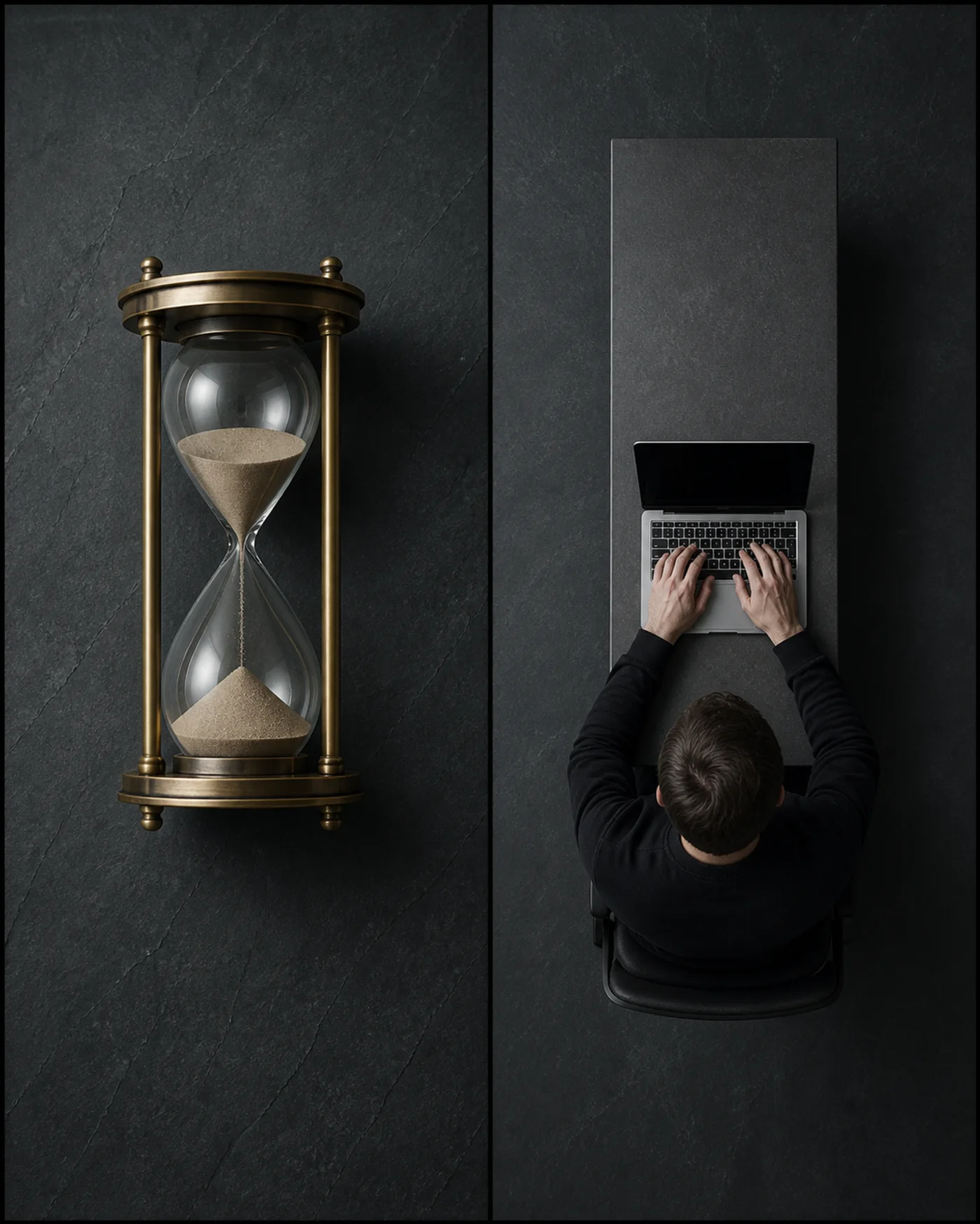
Then give it fifty minutes and stop when the timer stops. You will not get the two-hour version every time, because nobody does. You will get considerably more of them than you get by sitting down and hoping.
That's why I built this. I needed it. I spent years putting four hours' worth of vague in a box labelled one hour, and then wondering why the hour felt like sludge.
Sources
- Csikszentmihalyi, M. (1990). Flow: The Psychology of Optimal Experience. Book, cited by author and title, no DOI.