Watch yourself the next time somebody walks into the room while you're working.
Your posture changes before your brain does. You sit up. The tab you had open finds somewhere else to be. You start typing with a bit more intent, and for a few minutes you are, embarrassingly, a better version of the person who was sitting there ten seconds ago.
Then they leave. And within about three minutes you're on your phone.
I spent years reading that as a character flaw. Turns out it's one of the oldest documented effects in social psychology, and the paper that finally explained it ran the experiment on cockroaches.
The idea, named
Social facilitation. The audience effect. Somebody watching changes your performance.
Here's the thing that kept it stuck: the research contradicted itself constantly. Some studies found audiences made people better. Others found audiences made people worse. Same effect, opposite signs, and nobody could sort out why.
Robert Zajonc sorted it out in 1965, in a paper in Science that is about six pages long and reads like someone quietly ending an argument.
His answer: the presence of others raises arousal. Arousal strengthens whatever your dominant response already is. If you're good at the task, your dominant response is the right one, so an audience makes you faster and sharper. If you're still learning the task, your dominant response is the wrong one, so an audience makes you worse.
Not motivation. Not self-consciousness. Not wanting to look good. Arousal, doing what arousal does.
Zajonc, R. B. (1965). Social Facilitation. Science, 149(3681), 269 to 274. doi.org/10.1126/science.149.3681.269
The roaches
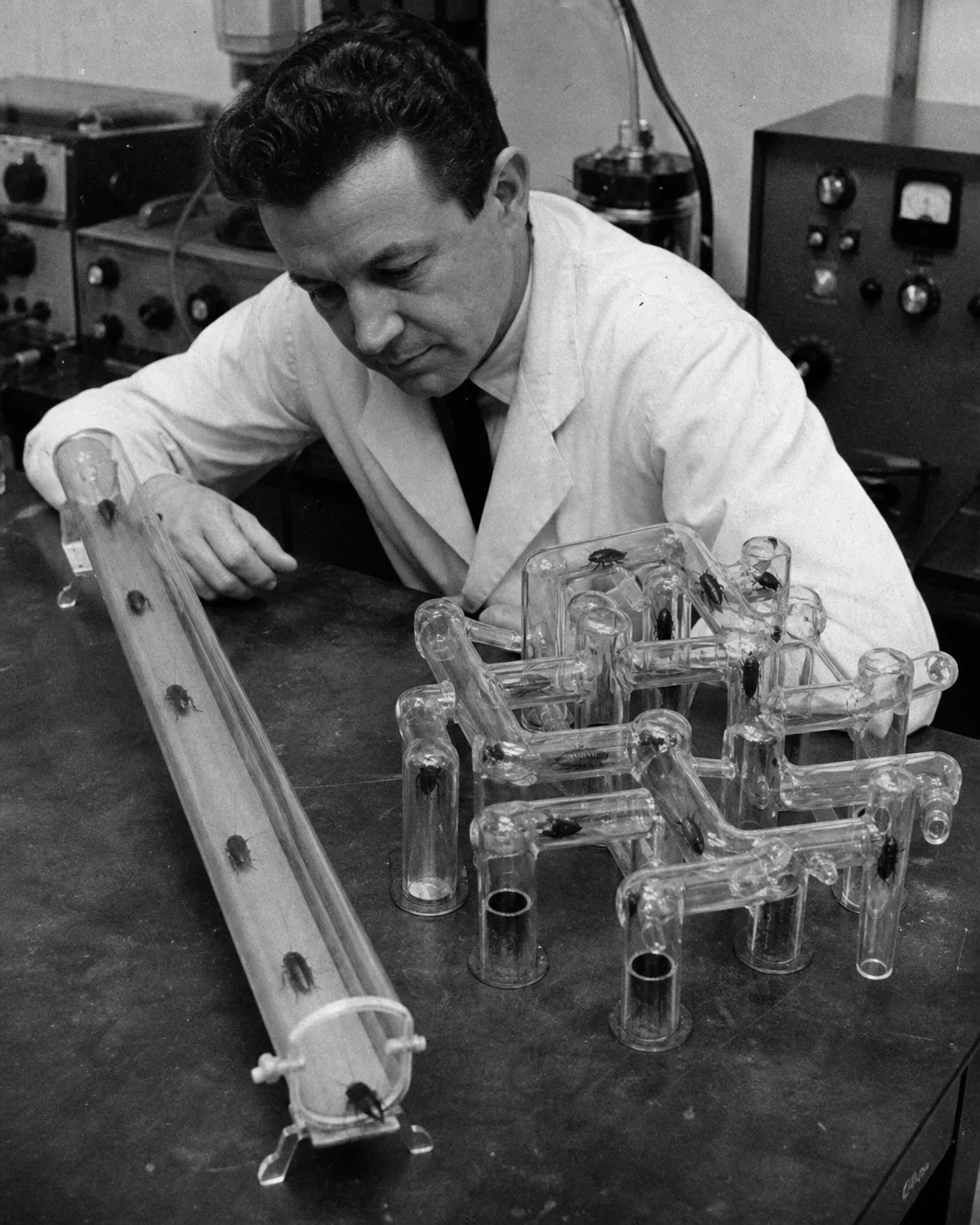
Here's where it gets good.
If the effect ran on ego, on caring what people think, on the social pressure of being observed, then it should be exclusively a human thing. So Zajonc went and ran it on cockroaches.
Roaches in a simple runway went faster with an audience of other roaches watching from side chambers. Roaches in a complex maze went slower.
No ego. No self-consciousness. No cockroach lying awake at 2am wondering if the other cockroaches judged its variable names. The effect is that primitive. It's below the part of you that has opinions about itself.

Which means you don't get to opt out of it by being self-aware. You've been trying to think your way around a mechanism that works on insects.
You have been trying to think your way around a mechanism that works on insects.
What this means for your build hour, specifically
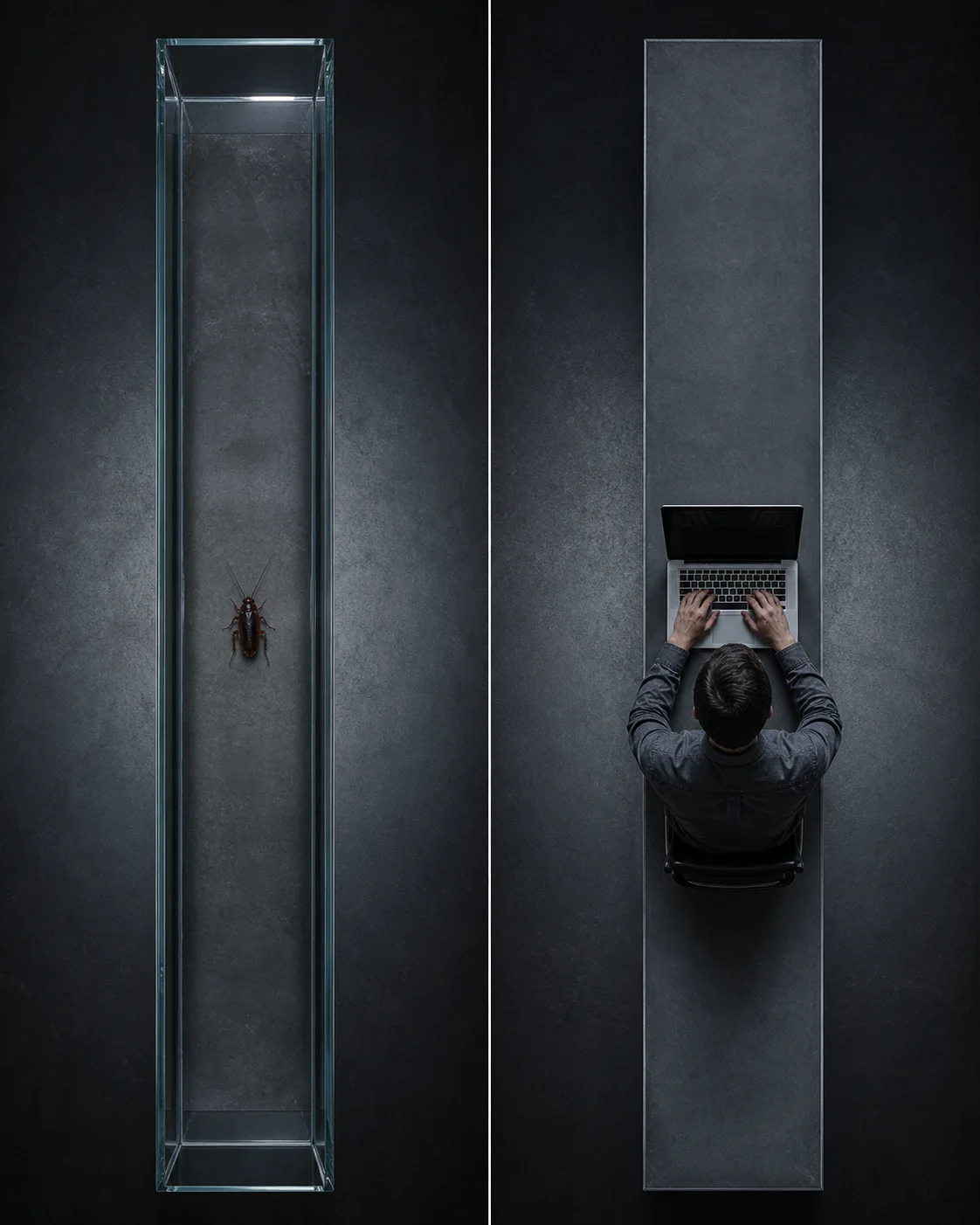
Now apply Zajonc's rule to what you actually do all day.
Most of a build hour is a practiced task. You're reading a diff in a codebase you know. You're writing a prompt for the fourteen-hundredth time. You're renaming things, wiring a route, chasing a bug through code you wrote last Tuesday. That's the simple runway. Watched, you go faster. That is not a motivational claim. That's the finding.
But the rule cuts both ways, and this is the part nobody selling you a focus app will mention.
If you're genuinely learning something new, if you're on the complex maze, an audience can make you worse. Being observed while you flail is not a productivity hack. It's the slow condition in the study.
So the design question isn't "how do I get watched more." It's "how do I get the arousal without the evaluation."
What we built, and why it's shaped like that
The answer we landed on: presence, no surveillance.
Live today, free plan:
The camera is on for the whole hour. That's not decoration and it's not for me. It's the mechanism. Somebody is there, and your nervous system knows it.
Nobody sees your screen. Not your partner, not me, not the app. The arousal comes from a face, not from an audit.
Mics are locked during the work phase. Your partner cannot ask how it's going. There is no performance to give, no progress report to narrate, nothing to be evaluated on mid-hour. That silence is deliberate. It's what keeps the complex-maze problem off the table, so being watched stays a runway and never becomes a test.
WHERE THIS LIVES IN THE PRODUCT
There's a Silent setting for people who want the presence and none of the social cost at all. Camera on, mic muted from the moment you enter, your partner sees a Silent chip so nobody's confused and nobody's offended. You wave. Then you work. That's a real option in the product because "I want a person there but I do not want to talk to a person" is a real thing to want, and pretending otherwise loses you the exact people this helps most.
In the group room at /friends, the whole wall is on camera at once, everyone in their own tile, all working. When the host brings someone on mic between rounds, that's the audience effect turned all the way up on purpose, for the ten minutes where turning it up is the point.
What I'm building next is the unmatched hour. Right now if nobody claims your slot you can still enter, the clock still runs, and the hour still counts toward your record. But you're alone in there, and Zajonc says alone is the weak condition. The fix in progress is a stand-in on the empty tile: me, live and mirrored into unmatched booths when I'm in a session, and a recorded hour of me working when I'm not. Labeled as recorded, always. I'd rather tell you it's a recording and have it work than pretend and have you find out.
The lineage, credited
I built this on other people's work and I'll keep saying so.
The direct parent is Matthew Larsen's Work Form System: a 60-minute unit, a written record of every hour, a wall of documents you read back, a small group that knows whether you showed up. Larsen is himself openly assembled from Hill on autosuggestion, Maltz on self-image, Cardone on 10X sizing, Hormozi on beliefs, traits and skills, Jobs via O'Leary on signal versus noise, Clear on the habit loop.
What we add is the one thing his system doesn't have, and it's exactly this mechanism. Larsen's accountability arrives after the hour. The form gets filled in, the ping goes out to the group, everyone finds out later.
Zajonc's effect doesn't work later. It works during. It requires a present observer, which is why a Slack message at 5pm about your 2pm session is a report and not a mechanism.
Focusmate has the presence and no protocol. Larsen has the protocol and no presence. We're the overlap, and that overlap is the entire reason this exists.
The honest ask
You already know this works. That's the annoying part. You've felt it in a library, in a coffee shop, on a call where you had your camera on, in every co-working space you ever paid too much for. You know exactly what happens to your focus when a person is present, and you have arranged your working life so that it almost never happens.
You built a setup where nobody is ever there. Then you went looking for an app to fix your discipline.
That's why I built this. I needed it. I work alone, in a room, in upstate New York, and the difference between a day I ship and a day I don't is whether a human being was on my screen at the top of the hour.
Sources
- Zajonc, R. B. (1965). Social Facilitation. Science, 149(3681), 269-274. https://doi.org/10.1126/science.149.3681.269
- PubMed record: https://pubmed.ncbi.nlm.nih.gov/14300526/