Your phone is not interesting. You know it is not interesting.
You check it anyway, forty times a day, and most of those checks return nothing at all. That is not a failure of the design. That is the design, and it is the oldest and best-documented behavioural technology anybody has ever pointed at a human being.
The uncomfortable part is that the same machinery is what makes anything worth coming back to. Including a room where you work.
The idea, named
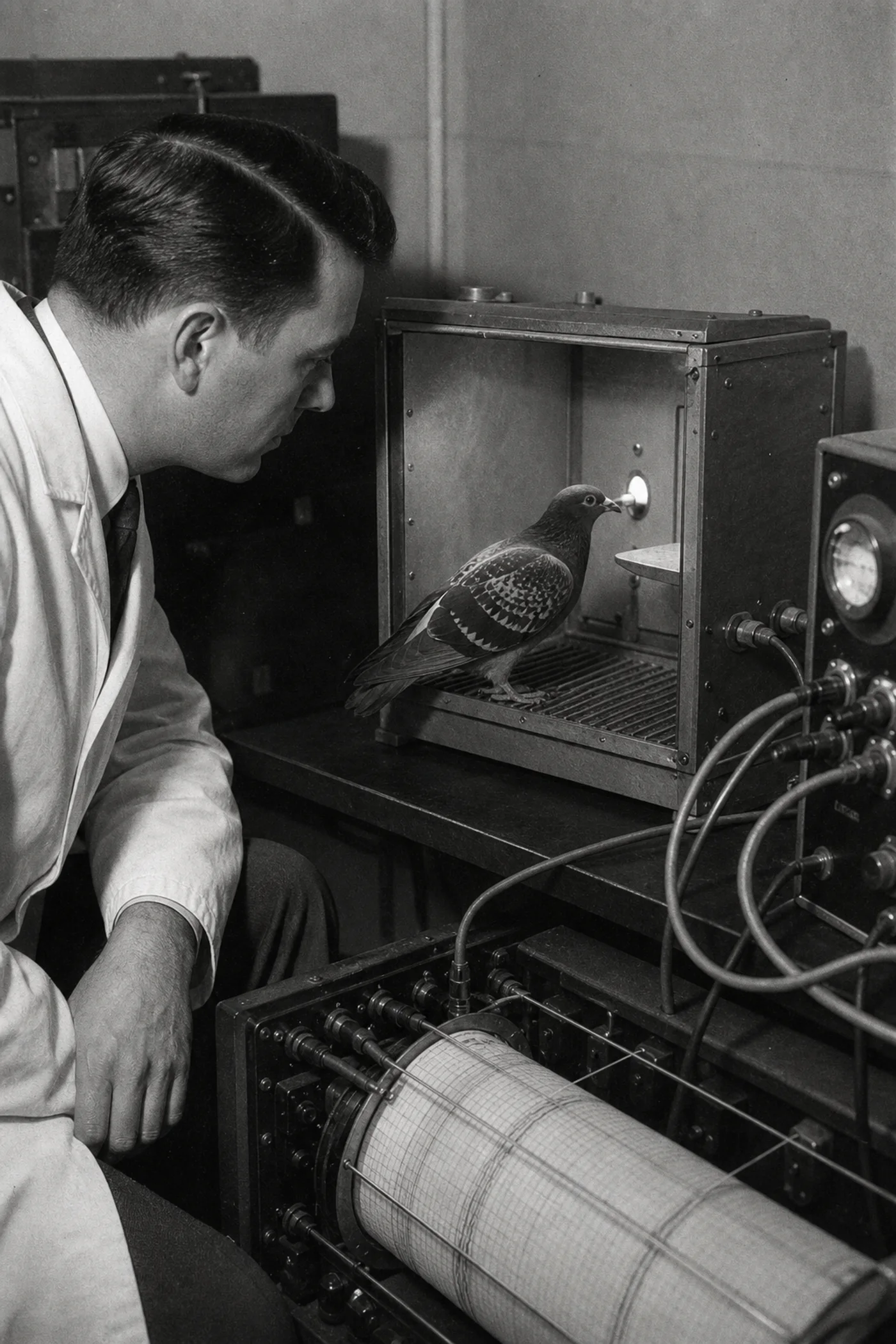
Variable-ratio reinforcement. Charles Ferster and B. F. Skinner, Schedules of Reinforcement, 1957, which is a very long book about what happens when you change how often a reward arrives rather than what the reward is.
The core result is the one people half-remember and it is worth stating precisely.
If a reward arrives every time, the behaviour is easy to establish and easy to kill. Stop rewarding it and it stops fast, because the absence is obvious immediately.
If a reward arrives on an unpredictable schedule, the behaviour is slower to build and extremely hard to extinguish. There is no obvious moment where you can tell it has stopped paying, so there is no clean point at which you quit.
Ferster, C. B., & Skinner, B. F. (1957). Schedules of Reinforcement. Cited by author and title. Book, so no DOI and no link, which is the honest version rather than a missing one.
Predictability is also what kills a reward's ability to be noticed at all. A thing that always arrives, in the same form, stops registering as anything within about a week. It becomes furniture. Variation is what keeps it a thing that happened rather than a thing that is always there.
The part where I take this seriously
Here is where most productivity writing gets uncomfortable and skips ahead, so let me not.
This mechanism is why the apps you resent are hard to put down. It is the machinery under infinite scroll, under pull-to-refresh, under every notification badge that might be nothing. Nobody stumbled into that. It is applied Ferster and Skinner, and it works exactly as advertised.
Which means when I use it, I am using the same tool, and the only thing separating my version from theirs is where I point it.
So here is the line I drew, and you can hold me to it.
Nothing in this product uses a variable schedule to pull you in. No notification that might be something. No badge that might be nothing. The chain does not warn you it is in danger. The distraction counter says nothing while you work. Every one of those would work, in the sense that it would raise engagement, and every one of them would be me taking your attention rather than protecting it.
The variation sits at the end, on the far side of work you already chose to do. That is the whole difference and it is not a small one.

This is the most powerful mechanism on the list and the only one I have deliberately used less than I could.
The lineage, credited
The direct parent of what I built is Matthew Larsen's Work Form System: a 60-minute unit, a written record of every hour, a wall of documents you read back, a small group that knows whether you showed up. Larsen is openly assembled from Hill on autosuggestion, Maltz on self-image, Cardone on 10X sizing, Hormozi on beliefs, traits and skills, Jobs via O'Leary on signal versus noise, Clear on the habit loop.
This is the one mechanism on the list where I do not think he is using it, and I am not sure it is a gap.
His close is a sticky note and a mark on a calendar, and it is identical every single hour. Perfectly fixed, perfectly reliable, and it works for him. Fixed rewards are not useless. They are just quieter, and they fade, and his system compensates with a group that notices.
What we add is variation inside the close, for the specific reason that a solo builder does not have his group.
What we built
The wrap is the same shape every time. What lands inside it is not.
Same clock, same sequence, same order, same place. Then a drop, generated for that session. Sometimes a clip. The specifics change and they are not supposed to be predictable.
WHERE THIS LIVES IN THE PRODUCT
Two rules, and they pull in opposite directions on purpose.
The frame does not vary. Everything around the reward is rigid, because the frame is doing conditioning work and a booth that surprises you predicts nothing. The variation is allowed in exactly one slot, and it is the last one.
It arrives after the work or not at all. Never at the fifteen-minute mark, never for a nearly-finished hour, never as a nudge to come back. A variable reward placed before the work is a slot machine. Placed after it, it is the reason the room stays interesting in month four.
There is a version of this I have not built yet, and I want to name it in the right tense. The plan is a bell-aware distraction counter: when you are building with AI you are genuinely waiting on a model, and the notification that says your build finished is a sanctioned interrupt rather than a distraction. Counting a belled switch the same as opening a news tab is dishonest measurement. Sorting one from the other is what I am building next. It does not exist today.
The ask
Go and find where a variable schedule is currently pointed at you.
It will not be hard. Check which app you opened most times yesterday and ask what fraction of those opens returned anything you wanted. That gap, between how often you check and how often it pays, is the mechanism working on you at full strength.

You are not going to win that fight with willpower, and this whole series argues you should stop trying. Move the good uncertain thing to the far side of the work instead, and let the machinery run in the direction you actually chose.
That's why I built this. I needed it. I am extremely easy to operate with an unpredictable reward, which is exactly why I was careful about where I put one.
Sources
- Ferster, C. B., & Skinner, B. F. (1957). Schedules of Reinforcement. Book, cited by author and title, no DOI.