Somebody sat on your couch once while you did your taxes.
They weren't helping. They didn't know anything about taxes. They were on their phone the entire time. And you got through the whole thing in one sitting, the thing you had been avoiding for five weeks, and afterward you thought: that's stupid. That shouldn't have worked.
It works. It has a name now. And the story of how it got that name is the most honest thing in this entire series.
The idea, named
Body doubling. Another person present while you work, doing their own thing, not helping, not supervising, frequently not even talking. Their presence is the entire intervention.
It comes out of the ADHD community. Not a lab. Not a paper. People who could not start things discovered that another human in the room made starting possible, told each other, and it spread as folk knowledge for years.
In 2023 a group of researchers finally sat down and described it properly. Eagle, Baltaxe-Admony and Ringland, at ASSETS, proposing body doubling as a continuum rather than one fixed thing: it varies by whether you share space, whether you share time, and how much mutual attention is involved. Sitting silently in the same room and a muted video call at 6am are both body doubling, at different points on the same dial.
Eagle, T., Baltaxe-Admony, L. B., & Ringland, K. E. (2023). ASSETS '23. doi.org/10.1145/3597638.3614486 · Free PDF
The number, and what it actually tells you
They surveyed 220 neurodivergent people.
The finding that stopped me: most of them had been doing this for years before they ever heard the term.
Sit with that. Not "most of them found it helpful when we suggested it." They had independently invented it, were already relying on it, and had no word for it. The practice was fully formed in the wild and the academy showed up late with a clipboard.
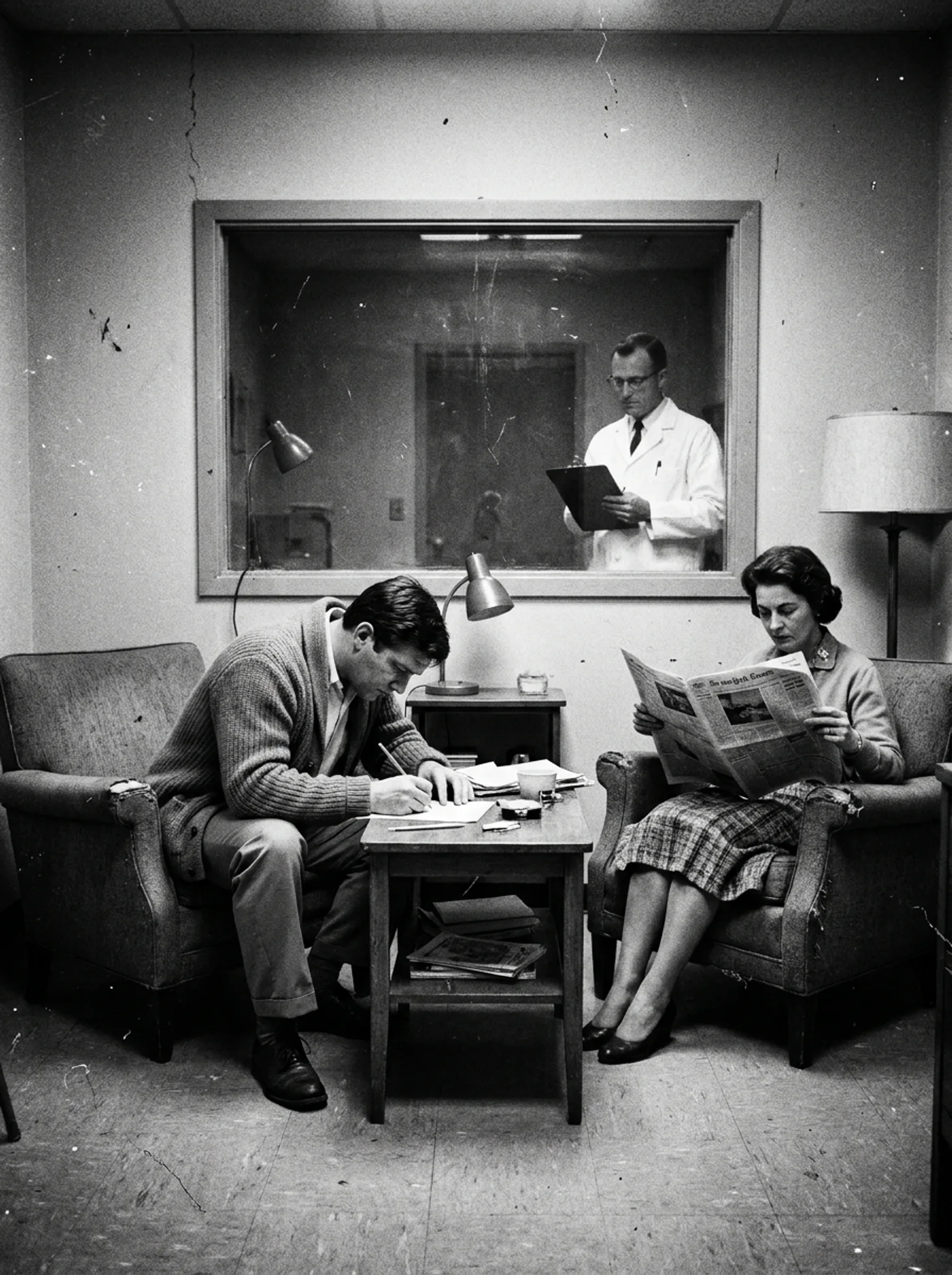
There's a newer strand too. Ara and colleagues (2025) took it into virtual reality, which tells you where the interest is heading: arxiv.org/abs/2509.12153.
Now the part where I undercut myself
Here is the honest note, and I would rather lead with it than have you find it.
The controlled evidence for body doubling is young and it is mixed. The Eagle paper says so itself. Controlled studies have not shown conclusive effects. If you want a d value and a meta-analysis with 94 tests behind it, go read the piece on implementation intentions, because this is not that.
So why is it in the product at all, and near the middle of it?
Because "the labs have not conclusively measured it yet" and "it does not work" are completely different sentences, and the productivity industry relies on you not noticing the difference. The right framing is this: the ADHD community proved it in the field first, and the labs are still catching up. Two hundred and twenty people who had never heard the word were already doing it. That is not nothing. That is a signal loud enough that the researchers went looking.
I would rather tell you the evidence is young than dress up a survey as a randomized trial. If the studies land badly in three years, I will say so on this page.
The people it works for figured it out on their own, gave it a name, and built their working lives around it while the literature was still catching up.
The lineage, credited
The direct parent of what I built is Matthew Larsen's Work Form System: a 60-minute unit, a written record of every hour, a wall of documents you read back, a small group that knows whether you showed up. Larsen is openly assembled from Hill on autosuggestion, Maltz on self-image, Cardone on 10X sizing, Hormozi on beliefs, traits and skills, Jobs via O'Leary on signal versus noise, Clear on the habit loop.
And Larsen does not have this one. His system has no person in it while you work. The accountability arrives afterward: you fill in the form, the ping goes out to the group. Focusmate has the opposite shape, a real human on camera with no protocol running underneath.
This mechanism is the reason we sit in the overlap instead of picking a side.
What it looks like when someone built the room around it
Live today, on the free plan:
A partner tile. One other person, on camera, doing their own work, for the length of the session. They are not your coach. They will not ask what you're building. They are, in the most literal sense, just there.
WHERE THIS LIVES IN THE PRODUCT
Mics are locked while the timer runs, which is the part people are surprised by. If presence is the mechanism, conversation is not a bonus, it is interference. Nobody has to perform.
There is a Silent setting for people who want it further down the dial: camera on, mic muted from the second you enter, your partner sees a Silent chip so nobody reads it as rudeness. You wave, then you work. That option exists because "I want a person there but I absolutely do not want to talk to a person" is a real thing to want, and a product that pretends otherwise loses the exact people this helps most.
At /friends it scales up: a whole wall of tiles, everyone in their own square, everyone working.
And what I'm building next is for the hour nobody claims. Right now if your slot goes unmatched you can still enter, the clock still runs, and the hour still counts on your record. But you're alone in there, which is the weak version. The fix in progress puts a stand-in on the empty tile: me, live and mirrored in while I'm in a session, and a recorded hour of me working when I'm not. Labeled as recorded, always. I would rather tell you it's a recording than have you find out.
The ask
You already have the couch story. Everyone does. A library, a coffee shop, a friend who sat there while you finally called the insurance company.
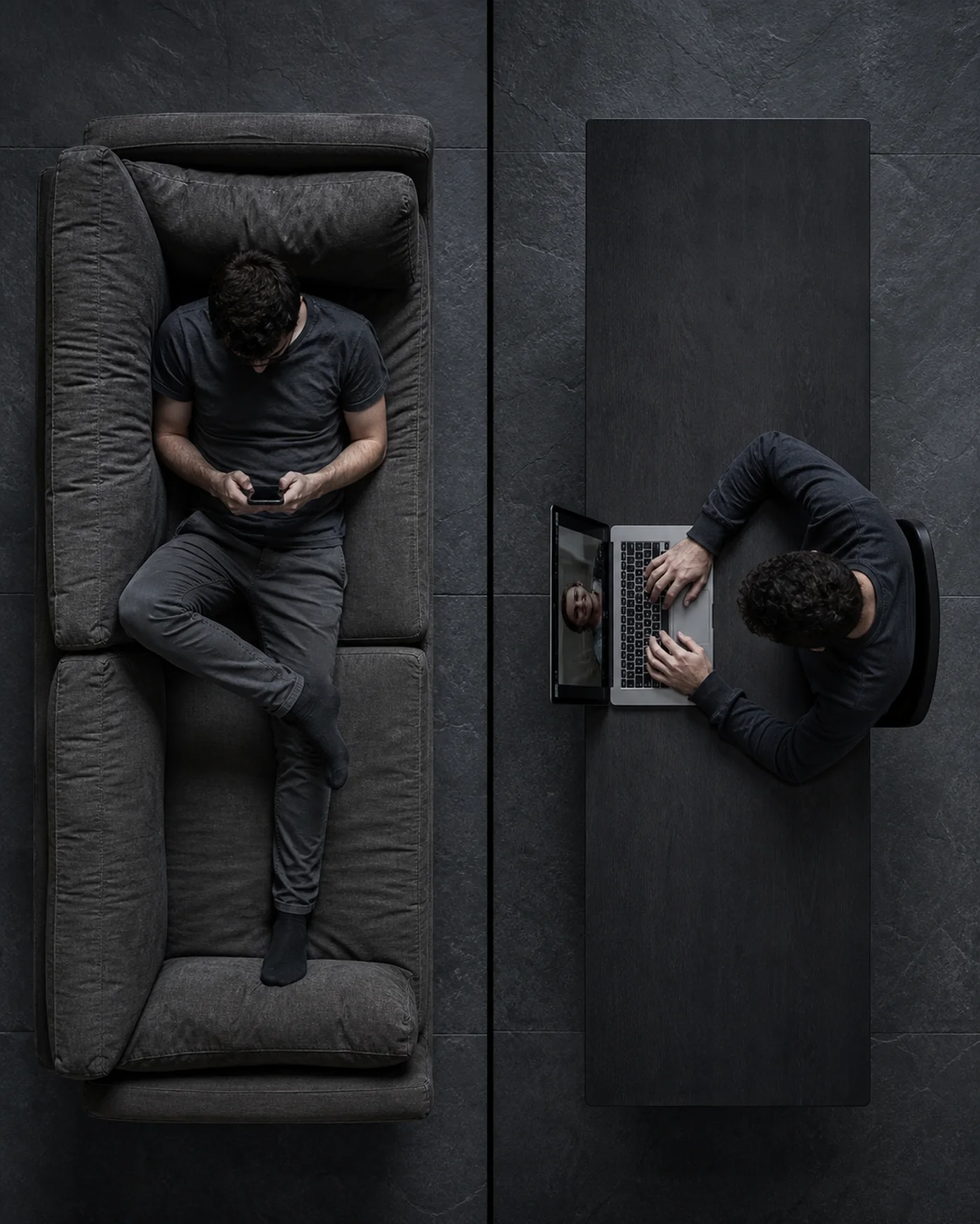
You know this works on you. You have known for years. And then you built a working life in which it happens approximately never, and went looking for an app to fix your discipline instead.
That's why I built this. I needed it. I work alone in a room in upstate New York, and the difference between a day I ship and a day I don't is whether a human being was on my screen when the timer started.
Sources
- Eagle, T., Baltaxe-Admony, L. B., & Ringland, K. E. (2023). Proposing Body Doubling as a Continuum of Space/Time and Mutuality. ASSETS '23. https://doi.org/10.1145/3597638.3614486
- Free PDF: https://leyabreanna.com/papers/body_doubling.pdf
- Ara, Z., et al. (2025). You Are Not Alone: Designing Body Doubling for ADHD in Virtual Reality. arXiv:2509.12153. https://arxiv.org/abs/2509.12153