Put a tally counter on your desk. Click it every time you leave the tab.
Do not tell anyone. Do not report the number. Do not set a target. Just click it, honestly, for one working day.
Your count will be lower than a normal day. Not because you tried harder. You did not decide to try harder. The counting did it.
That is the whole mechanism, and the story of how we know about it is a small disaster that turned out fine.
The famous version, which is wrong
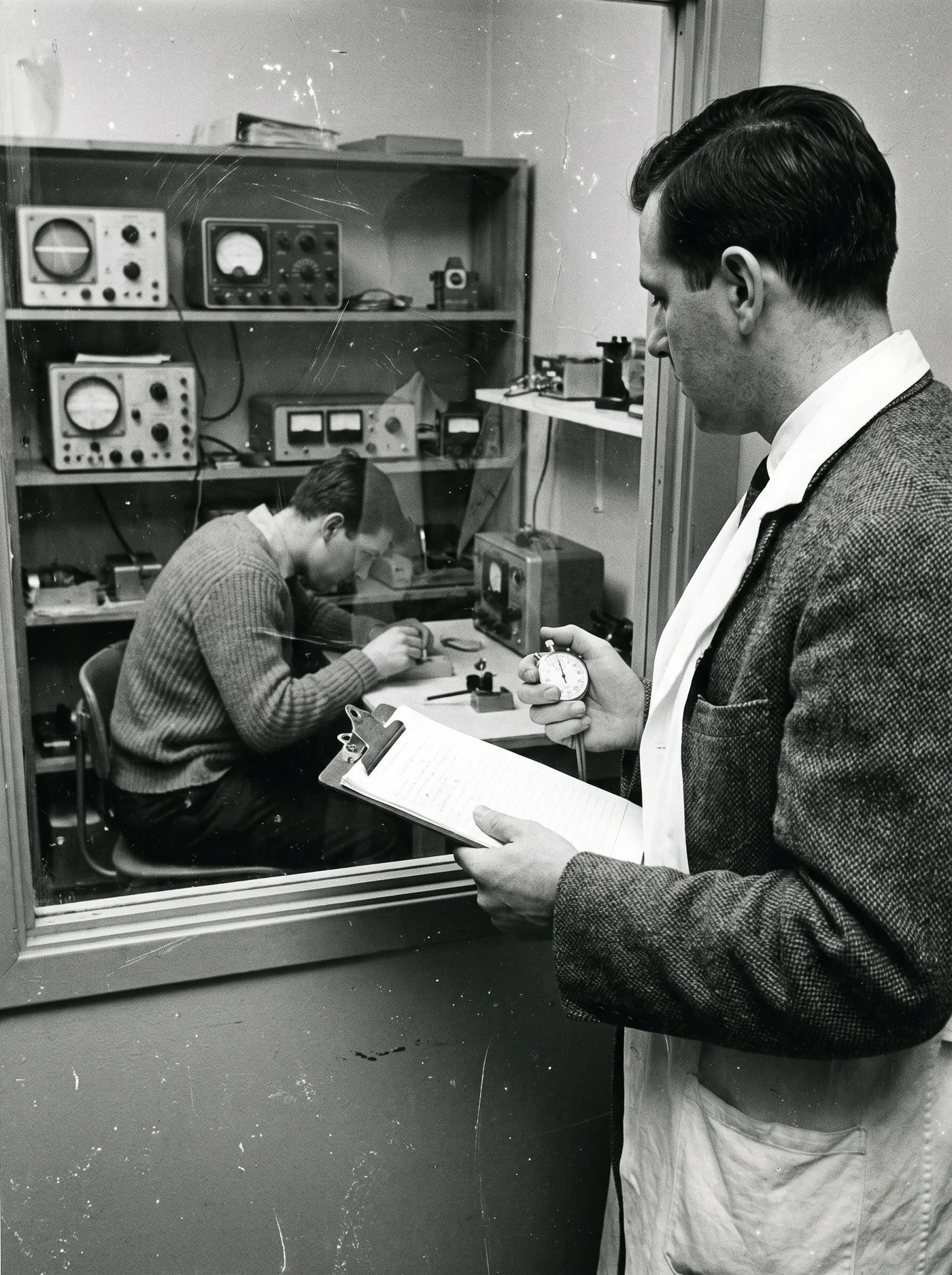
You have heard of the Hawthorne effect. Workers at a factory outside Chicago, lighting turned up, productivity rose. Lighting turned down, productivity rose again. Conclusion everyone repeats at conferences: people work harder simply because they are being observed.
It is a great story. It has been told for ninety years. And the strong version of it does not survive contact with the data.
For a long time nobody could check, because the original records were believed destroyed.
What actually happened
Steven Levitt and John List went looking anyway, and found the original Hawthorne data sitting in two library archives. Then they re-analysed it.
The famous pattern, the one where productivity rises with every single lighting change, is not in the data. It is an artifact of how the story got retold. The tidy version people quote is, functionally, fiction.
Levitt, S. D., & List, J. A. (2011). American Economic Journal: Applied Economics, 3(1), 224 to 238. aeaweb.org · Free NBER version
But something did survive, and it is subtler and more useful than the myth. Output ran higher while experiments were running at all. Not tracking the lighting. Tracking the being-measured.
That is why I say measurement reactivity and never "the Hawthorne effect proves." The brand name got debunked. The thing underneath it did not.
The counter is not there to judge you. It is there to be visible. That alone moves the number.
Why I lead with the debunk
Because everyone else buries it, and burying it is how you end up with a product built on a myth.
If the strong Hawthorne story were true, the correct product is surveillance. Watch everything, report everything, because observation itself is the magic. That is the logic behind every employee-monitoring tool ever sold, and it is why those tools feel the way they do.
What actually survived is narrower and gentler: a number being kept changes behaviour, and the number does not need an audience. It does not even need to be read afterward. It needs to exist and you need to know it exists.
Those two readings build very different software. One builds a manager's dashboard. The other builds a counter that only you ever see.
The lineage, credited
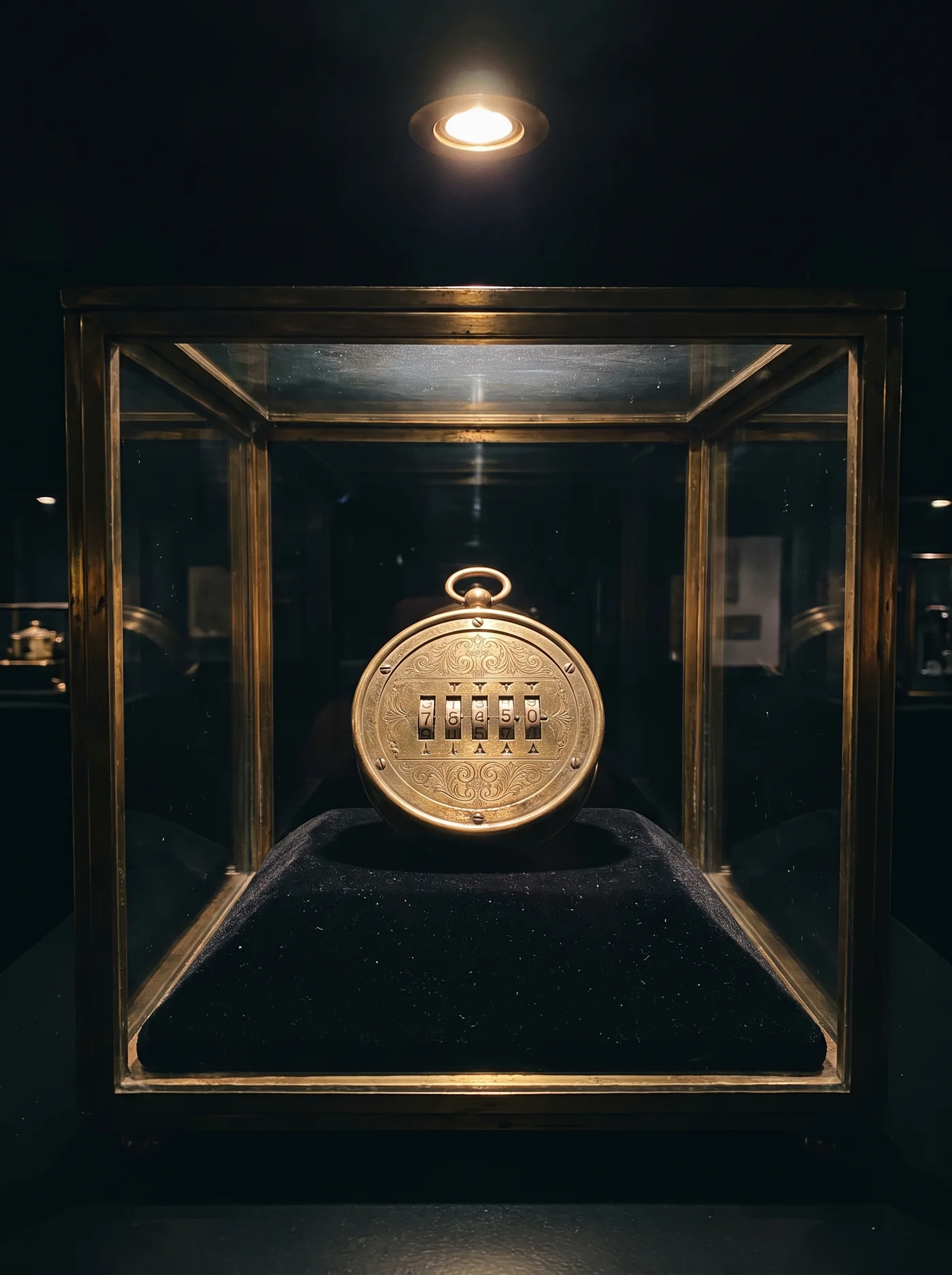
Matthew Larsen's Work Form System is the direct parent of what I built: the 60-minute unit, the written record of every hour, the wall of documents, the small group that knows whether you showed up. Larsen himself is openly assembled from Hill, Maltz, Cardone, Hormozi, Jobs via O'Leary, and Clear.
His Work Form is this mechanism, running at full strength, on paper. Every hour gets written down: what you did, which category it belonged to, how many times you got distracted. His own line for why it works is better than anything I could write: tracking prevents you from lying to yourself.
What we add is the timing, as always. Larsen's record is filled in after the hour and reviewed by a group afterward. Ours runs during, with a person on the other side of the screen while it runs.
What we built, and the one rule it follows
There is a counter in Deep Mode that watches how many times you leave the tab while the timer is running. It debounces, so a flicker is not counted as two.
Here is the rule it follows, and it is the whole design:
It shows you nothing during the hour.
No badge. No warning. No little red number climbing in the corner. Nothing that turns your work into a game you are losing in real time. At the end, one quiet line: left the tab three times. Then it asks you one question about why, with five options, and the honest one is usually right there.
WHERE THIS LIVES IN THE PRODUCT
That restraint is the mechanism, not a compromise on it. If the counter nagged you it would become a thing you manage. Sitting silent, it stays a thing you know about. Knowing is what moves the number.
The wrap-up also asks which of your five goals the hour served. Same principle: a small, honest measurement, taken every time, seen only by you.
None of this is available on the free plan, and I would rather say that plainly than blur it. The free session gives you the room and the person. The measurement layer comes with Full Access.
The uncomfortable part
You have a rough idea of how much of your day is real work. You have never counted.
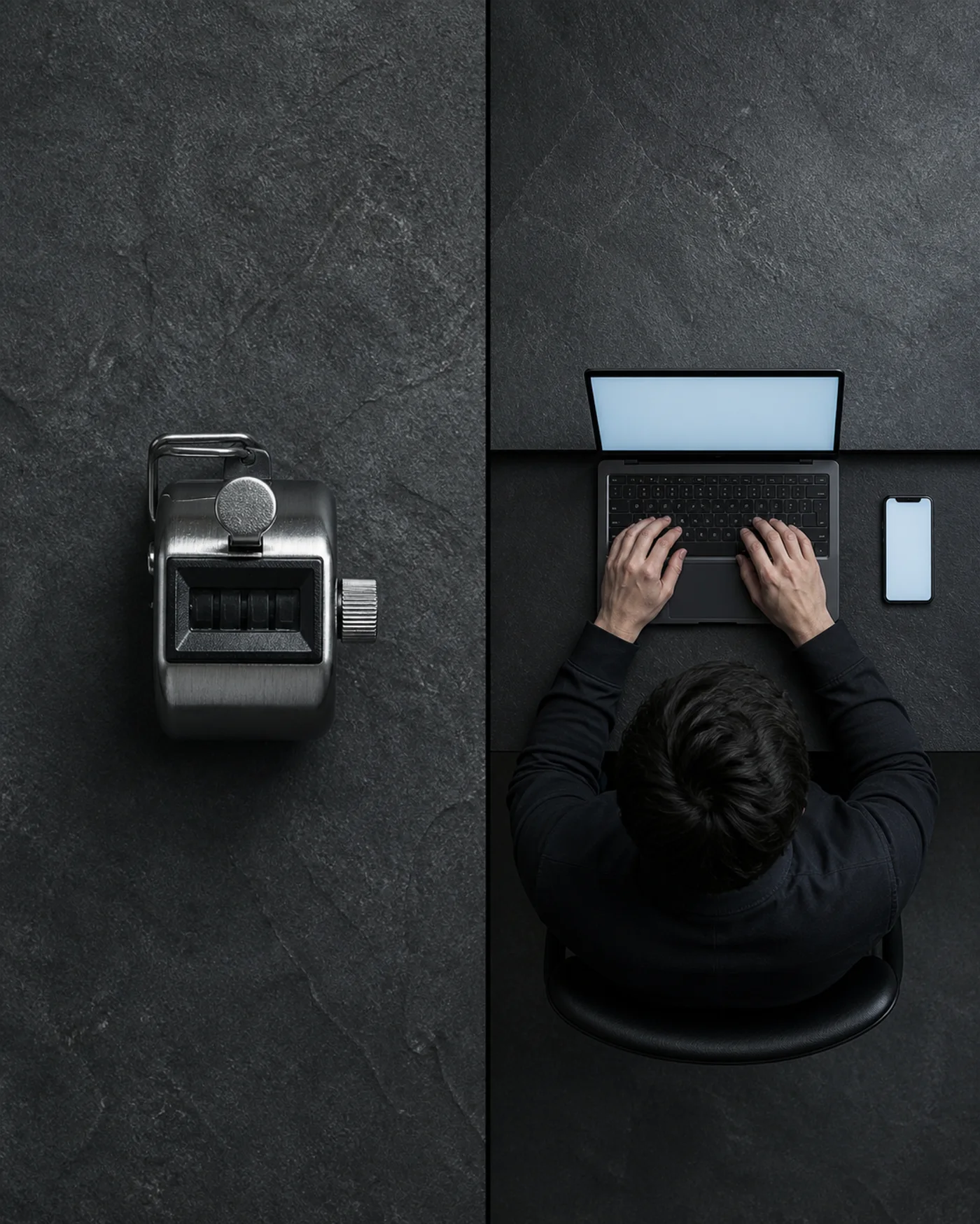
That is not laziness. It is the sensible move, if you suspect the number is bad and you would rather not have it. An uncounted day can be described however you like afterward. A counted one cannot.
Which is exactly why counting works, and exactly why you have been avoiding it.
That's why I built this. I needed it. I have a counter running on my own hours and I did not enjoy the first week of it at all.
Sources
- Levitt, S. D., & List, J. A. (2011). Was There Really a Hawthorne Effect at the Hawthorne Plant? American Economic Journal: Applied Economics, 3(1), 224-238. https://www.aeaweb.org/articles?id=10.1257%2Fapp.3.1.224
- Free NBER working paper: https://www.nber.org/system/files/working_papers/w15016/w15016.pdf